Before the Clock: How Chess Became a Timed Contest
Learn how chess clocks reshaped competitive play, making thinking time visible and giving opponents and organizers a shared way to manage a game.
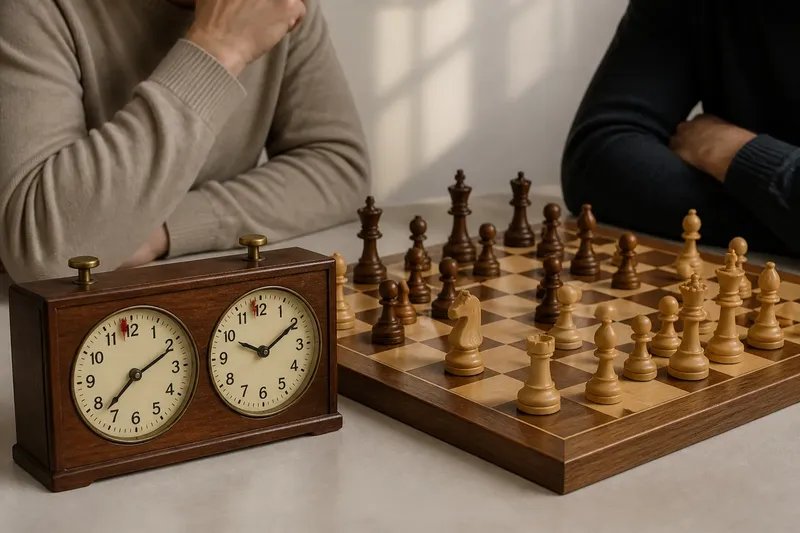
A player studies a difficult position while an opponent waits beside the board; without a clock, neither can point to a shared limit on that pause. Chess clocks made thinking time visible and gave competitive games a way to manage delay. The change was gradual, and timed play did not replace every form of untimed chess.
What was chess like before clocks?
Chess was played without clocks, and early competitive games could involve long waits. That does not mean every untimed game lasted without limit: players faced fatigue, social expectations, and the practical closing time of a venue. The difference was that no standard device tracked each player’s thinking time.
For match organizers, an open-ended pause could make schedules difficult to plan. Players might also disagree about whether a delay reflected serious thought or an attempt to wear down an opponent. Without a shared timekeeping rule, the distinction could be hard to settle consistently.
It is more accurate to describe clocks as a response to practical problems in competitive play than as a single invention that instantly changed all chess. Their use spread over time, alongside different event practices and time limits.
Why did competitive chess adopt clocks?
A clock gave each player a defined amount of time and showed whose turn it was to use that time. With the familiar paired-clock arrangement, one player presses a control after moving; that action stops one side and starts the other. The procedure turns an invisible resource—thinking time—into something players and spectators can observe.
Mechanical clocks made this possible with paired displays and a switching mechanism. Digital clocks later offered different ways to show time and handle controls, but the central purpose remained: track each player’s allotted time according to the event’s rules.
Timed play also gave organizers a more workable basis for scheduling rounds and telling opponents what conditions to expect. A clock could not resolve every dispute, but it replaced vague judgments about delay with a record both players could consult.
How did a clock alter a player’s choices?
Under a time limit, a player must weigh the value of more analysis against the time left for later decisions. A complicated position may deserve careful calculation; a familiar or quiet one may call for a quicker choice. The clock does not identify the right move, but it makes time allocation part of the player’s judgment.
Say a player has several plausible moves and spends extra time comparing them. The player chooses a sound continuation, but the display now shows less time for the endgame. The observable tradeoff is clear: more thought went into the current decision, leaving less time for later ones.
Time pressure can affect how a player approaches a position. Someone with little time may prefer a line that is easier to play, while an opponent might keep the game complicated. Neither choice can be understood from the clock alone; the position and the event’s time rules matter too.
What does a chess time control specify?
A time control states how much time players receive and whether the allotment changes as the game proceeds. Some controls give each player a fixed amount for the game. Others add time after each move or provide a delay before the player’s main clock begins to run down.
An increment adds time after a move; a delay postpones the start of the countdown for a brief period. These arrangements change how time pressure develops, but neither removes the need to make decisions efficiently.
Before a game, check the event instructions for the starting time, any increment or delay, and what happens when a player’s time expires. Use the clock according to the event’s procedure and the device’s directions; local rules determine how specific situations are handled.
What questions help explain chess clocks?
Why do players press the clock after moving?
Pressing the clock ends one player’s time and starts the opponent’s, following the game’s timekeeping procedure. It is part of completing a turn under timed play, not a decorative gesture.
Does the clock decide who is winning?
No. The clock shows remaining time, while the pieces and position determine the state of the game. A favorable position with little time creates a different practical problem from a difficult position with plenty of time.
Why do some time controls add time per move?
An increment provides additional time as moves are made, while a delay postpones the countdown for a set interval. The details vary by time control, so check the event rules to know which arrangement applies.
What should I watch in a timed game?
Compare the players’ remaining time with the demands of the position. A noticeable time imbalance may help explain a simple choice or a risky continuation, but it cannot reveal everything a player considered.
What did the clock leave unchanged?
The clock did not change the legal moves or the need to make a coherent plan. It changed the conditions under which players choose those moves. A rushed decision is still judged by its effect on the position, even when the time pressure helps explain it.
A long pause is not automatically a sign of trouble, and a quick move is not automatically careless. A player may spend time because a position is critical, or move quickly because its ideas are familiar. Time offers context, not a transcript of someone’s thought process.
It is not worth trying to infer a player’s exact reasoning from the display alone. A glance at the clock cannot show which variations were considered. Watch how the move changes the position, then use the clock as one clue about the conditions in which it was chosen.
The history of chess clocks is a history of competitive structure as much as speed: they made a player’s use of time visible and gave matches a shared way to handle delays. When following a timed game, ask not only who has more time, but what each player still needs to decide before making the next move.