The Fork, the Pin and the Skewer: Three Attacks, Three Different Questions
Learn the difference between a chess fork, pin and skewer by asking what each attack threatens and which piece’s relationship makes the tactic work.
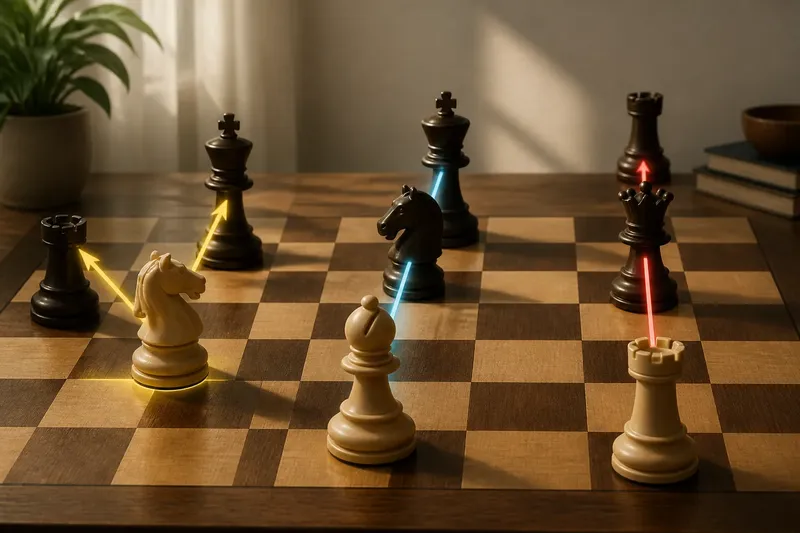
A knight lands on a square that attacks the king and a rook at once. That is a fork, but the name is less useful than the question it raises: which threat can the opponent answer first? In chess, a fork, a pin and a skewer each ask a different question about the relationships among pieces. Seeing those relationships makes the patterns easier to recognize than memorizing labels alone.
Here are three numbered ways to read the attacks. For each one, follow the line of threat, identify what the defender must protect, and consider what becomes possible after the first response.
1. Fork: Which threat can the opponent answer?
A fork is a single move that attacks two or more targets at the same time. The targets may be a king and a rook, two minor pieces, or a piece and a square that matters. The fork’s defining feature is not the attacker’s shape or the targets’ value; it is the simultaneous pressure from one piece.
A knight fork is especially easy to visualize because a knight attacks in short jumps and can threaten pieces on separate lines. But queens, pawns, bishops, rooks and kings can also fork. A pawn that advances while attacking two pieces is still creating a fork, even though the pattern looks different from a knight’s.
To read a possible fork, locate the attacking piece and list every square or piece it attacks after the move. Then ask whether the opponent can move one target while also dealing with the others. A king attack often dictates the reply because the king must be moved, shielded or the attacker captured before the opponent can address a second threat.
That forced reply is the practical point. If the opponent moves the king out of check, the other target may be left for capture. If both threatened pieces can escape or the attacker can be taken, the fork may not win material. The pattern describes the geometry; the position decides whether the attack succeeds.
Say you are considering a knight jump that checks the opposing king while attacking a rook. First verify that the knight cannot be captured and that the king has no useful way to block the check while protecting the rook. If the king must move and the rook remains exposed, the knight has created a meaningful fork; if a defender can capture the knight, the apparent double attack may be harmless.
When searching for forks, do not scan only for pieces that are already lined up. Ask which safe move by your piece could attack separate targets, especially after a check or a capture changes the opponent’s arrangement. Also check the opponent’s possible forks before moving valuable pieces onto squares where one attacker can reach both.
2. Pin: What is the piece protecting behind it?
A pin occurs when an attacking piece bears down on an opposing piece that stands in front of another target. The front piece is the blocker; the piece or king behind it is the reason moving the blocker may be costly. Bishops, rooks and queens can create pins because their attacks travel along a rank, file or diagonal.
When the piece behind the blocker is the king, the blocker cannot legally move if doing so would expose the king to check. This is an absolute pin. If the rear target is a queen, rook or another valuable piece, the blocker may legally move, but doing so could lose material. That is a relative pin, and its force depends on the position rather than a rule that forbids the move.
The useful question is not simply, “Is that piece pinned?” Ask what would be exposed if it moved, and whether the opponent can exploit that exposure. A pinned piece might still capture the attacker, move along the line without uncovering the target, or make a move that creates a stronger threat elsewhere. The label is a prompt to calculate, not a verdict that the piece cannot act.
For example, imagine a bishop attacking a knight on a diagonal, with the opponent’s king behind the knight. If the knight’s departure would uncover check, it is absolutely pinned and cannot legally leave the line. If a queen stands behind it instead, the knight may move, but you should check whether that lets the bishop capture the queen or opens another attack.
A pin can also be useful without winning the blocker immediately. The attacker may restrict the opponent’s choices, add pressure to the rear target, or bring another piece to attack the blocker. But if the blocker is defended and the rear target can simply move away, the pin may have little lasting force. Trace the whole line and identify what the attacker can actually do next.
3. Skewer: What must move out of the line?
A skewer is a line attack in which a more valuable piece is attacked first and a less valuable piece stands behind it. The front piece is compelled to respond to the attack, and its departure can expose the rear piece to capture. A bishop, rook or queen usually delivers the skewer because the tactic depends on a long, clear line.
The order of the targets distinguishes a skewer from the familiar pin. In a pin, the more vulnerable target is behind the blocker, so the front piece is reluctant or unable to move. In a skewer, the more valuable target is in front, so it is the one that must respond; the piece behind it is left exposed afterward.
To assess a possible skewer, trace the attacking line through both targets and consider every legal response by the front piece. It might move off the line, capture the attacker, or block the attack if the geometry allows. Only if that response leaves the rear piece capturable does the skewer create a concrete gain.
Imagine your rook attacks an opposing queen on a file, with an opposing rook farther down that same file. If the queen must move away and cannot capture or block the rook’s attack, the line opens and your rook may take the rook behind it. If the queen escapes with check or attacks a more valuable target, the skewer may not be favorable despite the alignment.
Skewers reward attention to what is behind the obvious target. Before making a line move, inspect the squares beyond the piece you attack; after facing one, do not assume the rear piece is lost until you have checked captures, blocks, counterchecks and safe queen moves. A threat can be real without forcing the outcome that first appears likely.
How do you tell these attacks apart?
Can any piece make a fork?
Yes. A fork is defined by one move attacking multiple targets, not by the kind of piece that makes it. Look for the simultaneous threats after the move, then check whether the opponent can answer both.
Does a pinned piece always have to stay put?
No. A piece absolutely pinned to its king cannot legally move if that would expose the king to check. A piece pinned to another valuable target may move, though the move can allow that target to be captured.
How is a skewer different from a pin?
Both use a line of attack through two pieces, but the order changes the question. A pin places the important target behind the blocker; a skewer attacks the more valuable front piece first and threatens what lies behind it.
What should I check before calling a tactic successful?
Check the attacker’s safety, the defender’s legal replies, and whether the threatened targets can move, capture or block. A recognizable pattern is only a candidate tactic until the position’s replies show what can actually be won.
4. Read the relationship before naming the pattern
At the board, use a simple visual routine. For a fork, follow the attacks leaving one piece. For a pin or skewer, trace a line through the attacker and its targets, then note which target sits in front and which sits behind. This keeps the three patterns separate without requiring a memorized diagram.
- Fork: One move threatens multiple targets. Ask which threat the opponent cannot answer.
- Pin: A blocker stands between an attacker and a valuable target. Ask what is exposed if the blocker moves.
- Skewer: A more valuable target is attacked in front of a less valuable one. Ask what the line reaches after the front piece moves.
- All three: Check whether the attacker can be captured, whether a target can escape with tempo, and whether the opponent has a counterattack.
It is not worth the effort to memorize a long catalog of named tactical patterns before you can trace attacks on the board. A label helps you communicate what you see, but the calculation still comes from the pieces’ legal moves and the opponent’s replies.
When a position looks tactical, say the relationship aloud: “This piece attacks two targets,” “this blocker shields the king,” or “the queen is in front of the rook.” That plain description often reveals the right candidate move. The names—fork, pin and skewer—then become concise ways to describe what the board is already showing you.